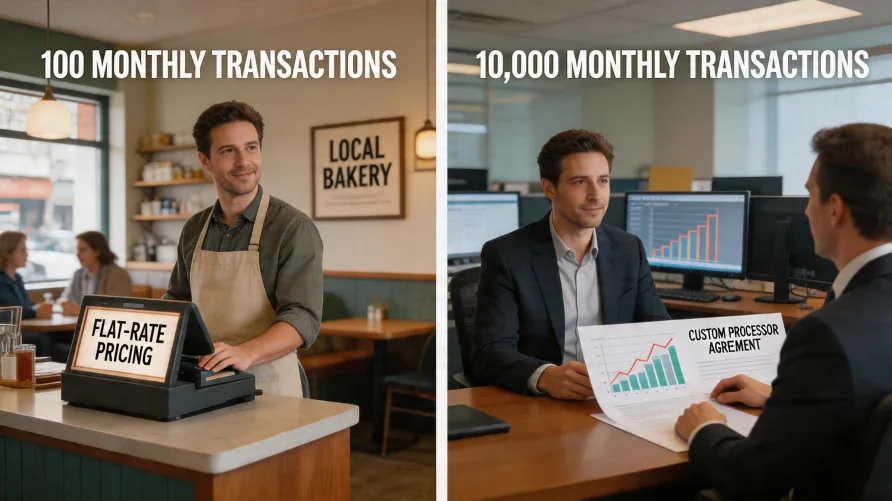
Scaling credit card processing volume from 100 to 10,000 monthly transactions changes more than your pricing. It changes whether you have an account manager, which fraud tools come standard, how reserves work, what triggers an underwriting review, and how much room you have to negotiate. The shifts happen in steps tied to specific volume thresholds, not gradually as you grow. From running businesses through a few of these transitions myself, I'll walk through what changes at each tier of growing business payment processing. This is written as a checklist by volume band, not a generic growth article. The reader is an operator already past the startup stage, thinking about what's next rather than setting up a first merchant account. Volume Milestones That Actually Trigger Change The exact numbers vary by provider, but the pattern is consistent across the major payment companies and matches the underwriting practices the card networks publish. Up to around 1,000 transactions per month, you're in the small-business pool. You sign up online, your pricing is published on a website, and your support is whoever's on shift in a queue. The processor isn't ignoring you, but the unit economics don't justify human attention. Between 1,000 and 5,000 transactions, you start crossing a threshold where a processor's mid-market team takes interest. You may get an outbound call from someone wanting to talk about a custom plan. You can ask for interchange-plus pricing and get a real answer instead of a referral back to the website. Between 5,000 and 25,000, you should have a named account contact, your pricing should be negotiable in writing, and the company will start asking for forecasts when your volume moves around. Reserves, if you have them, become a real conversation rather than a blanket policy. Above 25,000, you're in high-volume merchant territory. Pricing is bespoke, terms are written for your business specifically, and you have direct lines to underwriting and risk teams. The relationship works in both directions: they expect to know about new product lines or customer mixes before those changes show up in the data. The transitions aren't always handled gracefully. I've seen accounts sit on flat-rate pricing well past the point it made sense, simply because no one inside the processor flagged the upgrade and no one inside the business asked. Pricing Models Start to Matter Around 1,000 Transactions At 100 transactions a month, the math on flat-rate pricing is easy. You pay roughly 2.9% plus a fixed cents amount, you don't think about it, and the simplicity is worth more than any savings you'd capture by negotiating something custom. At 1,000 transactions, the math changes. If your average ticket is $80, you're processing $80,000 a month, or close to a million a year. Flat-rate pricing on a million dollars is considerably more expensive than interchange-plus, where you pay the actual cost the card networks charge plus a small markup to the processor. The difference often runs 30 to 60 basis points, which on a million dollars works out to $3,000 to $6,000 a year. That isn't enough money to switch processors over by itself. But it's enough to ask your existing processor for a custom rate, especially with consistent volume over six months and a clean refund and chargeback history. At 10,000 transactions on the same average ticket, you're processing close to ten million a year. The flat-rate-versus-interchange-plus difference on that volume can be $30,000 to $60,000 annually, which is real budget. By that point, you shouldn't be on flat-rate pricing anymore. If you are, that's a signal your processor isn't paying attention to your account, your account team didn't bring it up, or you didn't ask. Interchange-Plus Becomes Worth Asking For Interchange-plus pricing breaks down as: interchange (the variable fee the card networks charge based on card type, transaction type, and merchant category), plus a fixed processor markup, plus a per-transaction cents fee. The benefit is transparency. You can see what the networks are charging and what the processor is keeping. A few things to understand before you ask. First, interchange-plus quotes are usually expressed as something like "interchange plus 25 basis points and 10 cents," and the basis-point markup is the negotiable piece. The cents component matters at high transaction count and low ticket size. Second, your published interchange rates aren't the same as what you actually pay, because the card networks have hundreds of interchange categories and your real blended rate depends on your customer mix. Third, there's no published list of what your processor will accept. You have to ask, and you may need to ask twice. A reasonable starting request at 1,000 to 5,000 transactions is interchange plus 30 to 50 basis points. Above 10,000, you can typically push lower, depending on your card mix and average ticket size. Account Manager Access (and Why It Matters) Below 5,000 transactions a month, the math on dedicated human support doesn't pencil out for the processor. Above it, you become worth retaining, and account managers exist to retain you. What an account manager actually does, in my experience, is three things. They're a single point of contact for billing questions, dispute escalations, and product adds. They see your pricing internally and can request adjustments without sending you back through the sales queue. They're also the early warning system for risk reviews, although they don't always tell you in those words. If you have an account manager and you've never spoken to them, that's a missed opportunity, not a sign things are going well. Level 2 and Level 3 Data for B2B Sellers If you sell to businesses or government, the card networks publish reduced interchange rates for transactions that include extra data: tax amounts, customer codes, line-item detail, ship-to and ship-from addresses, and similar fields. These reduced rates are called Level 2 and Level 3 interchange. The savings are real. On commercial cards, the interchange difference between Level 1 (the default consumer-style data) and Level 3 (full line-item detail) can be 50 to 100 basis points. On a B2B business doing $5 million a year in commercial-card volume, that works out to $25,000 to $50,000 in annual interchange savings, captured by passing more data into the transaction. The reason most B2B businesses don't capture this is that the integration work isn't trivial. Your gateway has to support Level 2/3 data passage, your invoicing or commerce system has to populate the fields, and your processor has to be configured to submit them. None of those steps is technically hard, but they aren't automatic, and at small volumes, no one bothers. Past 1,000 to 2,000 transactions a month with a meaningful B2B mix, the savings start to justify the project work. Past 10,000, leaving Level 2/3 unconfigured is leaving money on the table. How Reserves Work at Different Volume Levels A reserve is money the processor holds back from your settlement, usually as a percentage of your volume, to cover potential chargebacks and refunds. Reserves come in three common forms. Rolling reserves hold a percentage of recent volume on a rolling basis, releasing each batch after a period of 90 to 180 days. Upfront reserves hold a fixed percentage immediately, typically required during onboarding for higher-risk merchants. Capped reserves hold up to a fixed dollar amount, then stop accumulating. The structure matters more than most operators realize. A 10 percent rolling reserve on $500,000 a month of volume parks $50,000 of working capital for three to six months, money that's yours but isn't accessible. The longer the rolling period and the higher the percentage, the more strain it puts on cash flow, especially during seasonal swings or growth periods when working capital is already tight. At 100 transactions a month, you probably don't have a reserve unless your industry is classified as higher risk. Reserves at small volumes are uncommon for low-risk merchants because the processor's exposure is small. At 1,000 to 10,000 transactions, reserves become more common, particularly if your refund rate runs above category norms or your chargeback rate is climbing. The processor's exposure is now real, and reserves are how they manage it. Reserves imposed mid-relationship, after you signed up without one, are usually triggered by underwriting reviews following a volume spike or a chargeback pattern change. At enterprise volumes, reserves become a negotiation. You can often get them reduced, capped, or removed entirely by demonstrating consistent performance and offering alternative protections like personal guarantees or prepayment terms. The lower your industry's risk profile and the cleaner your history, the more room you have. Reserves aren't punishment. They're risk management. If you understand the math the processor is doing, you can address it directly rather than negotiating in the dark. What Triggers Underwriting Reviews After You're Live Underwriting decisions aren't one-time events. Processors review accounts on an ongoing basis, and certain signals trigger fresh reviews even on accounts that have been clean for years. The common triggers are sudden volume spikes (more than two or three times your trailing average in a month), changes in average ticket size that look anomalous, refund rates exceeding category-typical bands, chargeback rates approaching the card networks' general thresholds, and category changes if you start selling product types your processor wasn't underwritten for. A sudden volume spike isn't bad in itself. The processor isn't punishing growth. They're reviewing whether the original underwriting still fits the business. The right response is to flag a spike before it happens if you know it's coming, and to provide forecasts and supporting documentation when asked. Higher Chargeback Thresholds Don't Apply at Scale A common misconception is that chargeback thresholds become more lenient at higher volumes. They don't. The card networks' published programs, including Visa's chargeback monitoring program and Mastercard's equivalent, apply across volume bands. The thresholds are expressed as percentages, not absolute numbers, so the card networks' rate-based monitoring catches you the same way at 100 transactions and at 100,000. What does change is that at higher volumes, you have access to more sophisticated tools to manage chargebacks: pre-arbitration response services, alert services that notify you of pending chargebacks before they post, dedicated chargeback analysts on the processor side, and dispute response automation. At small volume, you respond manually. At scale, you build a function around it. Negotiating Power Appears Around 5,000 Transactions Below mid-market volume, you take what's published. Above it, prices and terms are negotiable, but the negotiation isn't automatic. You have to ask, and you have to know what's actually movable. What's negotiable: the processor markup on interchange-plus pricing, the per-transaction cents fee, monthly minimum fees, gateway fees, statement fees, batch fees, PCI compliance fees, early termination penalties, and the size and structure of any reserve. What isn't negotiable: interchange itself, card network assessment fees, and regulatory compliance fees. The latter aren't keeping the processor's lights on. They're pass-through costs. A reasonable approach is to request a competitive bid every two to three years, even if you don't intend to switch. The bid gives you market data, and your incumbent processor knows you have it. Do You Need to Change Processors as You Grow? Sometimes, but not always. The decision depends on whether your current processor's enterprise tier actually exists and whether their account team responds when you ask for an upgrade. Many providers in this market service the full range of business sizes and will move you up tiers if you ask. Others are structured around a specific size band, and beyond it, the relationship gets thin. A few signals you've outgrown your processor. If you're paying flat-rate at 5,000-plus transactions a month and the response to a custom-pricing request is to point you back to the published page, that's one. If your account manager doesn't exist, doesn't return calls, or can't actually adjust anything, that's another. If your processor doesn't support Level 2/3 data submission, doesn't offer chargeback alert services, and doesn't have a real fraud product, you'll outgrow them whether or not anyone says so out loud. The right time to evaluate alternatives is before you need to. Reviews of providers in this market and the credit card processing ranking page on this site cover the relative strengths of the major options across the volume bands described above.
Scaling From 100 to 10,000 Monthly Transactions: What Changes