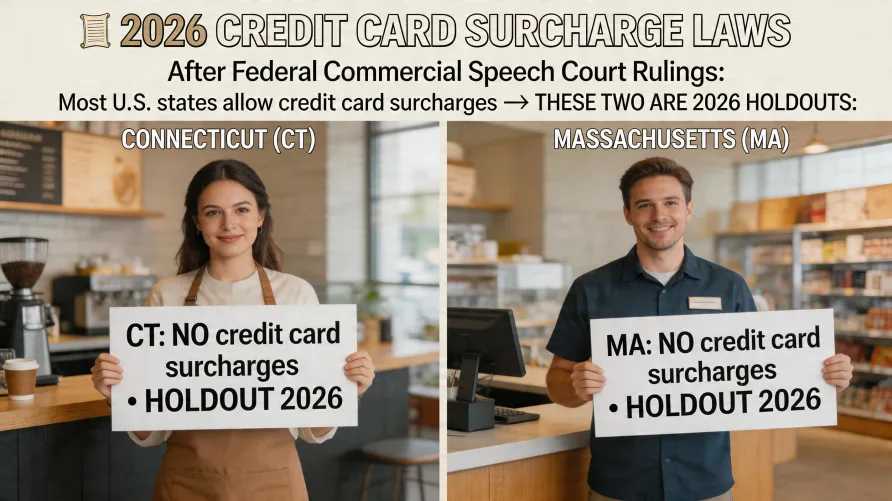
Credit card surcharge laws by state in 2026 break down into three rough categories: states that permit surcharging within the federal network framework, states that impose lower caps or stricter disclosure rules, and states that still prohibit the practice entirely. The federal framework from the 2013 card network settlements sets a 3% maximum cap on credit card surcharges nationally. Two states still ban surcharging outright, several others impose lower caps, and the rest follow the network rules with state-level disclosure requirements layered on top. Credit Card Surcharge Laws by State Trace Back to 2013 There isn't a single federal statute that authorizes credit card surcharging. The current rules trace back to a 2013 class-action antitrust settlement involving Visa and Mastercard, which lifted the long-standing prohibition the card networks had imposed on merchants who wanted to pass interchange costs to credit card customers. Before that settlement, network rules effectively prevented surcharging across all 50 states regardless of state law. Once the settlement took effect, surcharging became permissible at the network level subject to specific conditions. Merchants must register with each card network at least 30 days before adding a surcharge. Surcharges can't exceed the merchant's actual cost of acceptance for that card brand. Debit cards and prepaid cards are excluded regardless of state, because the Durbin Amendment to the Dodd-Frank Act treats them differently from credit cards. Receipts must display the surcharge as a separate line item, and disclosure is required at the point of entry to the business and at the point of sale. Network rules apply nationwide, and state law layers on top to either tighten them further or restrict surcharging beyond what the networks allow. How the 3% Cap Actually Works For roughly a decade after the 2013 settlement, the network cap on credit card surcharges sat at 4% of the transaction amount. Visa lowered its cap to 3% effective April 15, 2023, and Mastercard followed shortly after. As of 2026, the practical national ceiling is 3%, with the additional rule that a surcharge can't exceed the actual cost of acceptance for that specific card brand. If a merchant's average effective rate on Visa transactions runs 2.4%, the surcharge on Visa cards can't exceed 2.4%, even though the network would technically allow 3%. The cost of acceptance calculation includes interchange fees, network assessments, and the per-transaction processing markup applied by the merchant's processor. It doesn't include items like terminal rental, monthly statement fees, or PCI compliance fees, which sit outside the per-transaction cost structure. Documenting that calculation matters in any later audit or merchant services dispute. This is sometimes called the "lower of" rule. Surcharge at the lower of 3% or your actual cost. Misapplying it is one of the more common compliance failures, especially among small merchants who set a flat 3% across all card types without tracking their effective rate by brand. The 3% figure shows up in state statutes that reference network caps as a benchmark, and it appears in disclosure templates that merchant services providers distribute to clients. Treating it as a hard ceiling rather than a default starting point reflects current practice better than treating it as a target. States That Permit Credit Card Surcharging The majority of U.S. states permit credit card surcharging in 2026, subject to network rules and disclosure requirements. In these states, a merchant who registers with the card networks, posts the required signage, and itemizes the surcharge on the receipt is generally compliant. States that allow surcharging without state-imposed caps below the network ceiling include Alabama, Alaska, Arizona, Arkansas, Delaware, Georgia, Hawaii, Idaho, Illinois, Indiana, Iowa, Kentucky, Louisiana, Maryland, Michigan, Minnesota, Mississippi, Missouri, Montana, Nebraska, Nevada, New Hampshire, New Jersey, New Mexico, North Carolina, North Dakota, Ohio, Oregon, Pennsylvania, Rhode Island, South Carolina, South Dakota, Tennessee, Vermont, Virginia, Washington, West Virginia, Wisconsin, and Wyoming. The District of Columbia also permits surcharging. Several states that historically banned the practice have either had their statutes struck down by federal courts or amended their laws to align with the network framework. Florida, Texas, California, and Oklahoma all had bans that federal appellate courts found unconstitutional on First Amendment grounds, treating the bans as restrictions on commercial speech rather than economic regulation. The bans in those states aren't enforceable as written, although the underlying statutes haven't always been formally repealed. States That Ban Credit Card Surcharging As of writing, two states maintain enforceable prohibitions on credit card surcharging: Connecticut and Massachusetts. Puerto Rico also restricts the practice as a U.S. territory. Connecticut's prohibition appears at Conn. Gen. Stat. section 42-133ff and applies to most retail merchants accepting credit cards from Connecticut consumers. The statute treats a surcharge as an unfair trade practice. Connecticut does permit cash discounts, and the distinction between a surcharge and a cash discount remains the primary compliance path for merchants in the state. Massachusetts maintains a similar prohibition under Mass. Gen. Laws ch. 140D, section 28A, which forbids sellers from imposing a surcharge on a buyer who pays by credit. The Massachusetts Attorney General's office has historically enforced this provision, and the state hasn't amended the statute despite the broader national shift. Cash discounts remain permitted in Massachusetts as well. A merchant operating in either state needs to be careful with how a price differential is structured. The legal distinction is whether the credit price is the regular price with a surcharge added, or whether the cash price is the discounted version of a higher posted price. The latter is allowed. The former isn't. States With Specific Caps and Conditions Several states allow surcharging but impose conditions that go beyond the network rules. Colorado caps credit card surcharges at 2% under HB21-1316, which took effect in July 2022. The Colorado cap applies regardless of the merchant's actual cost of acceptance, so even if the network would permit 3%, a Colorado merchant can't exceed 2%. Maine permits surcharging but requires that any surcharge be clearly disclosed as a percentage of the transaction. The Maine Attorney General's office has issued guidance reinforcing that disclosure must occur before the customer enters into the transaction. New York permits surcharging but, since February 2024, requires that the total dollar amount the customer will pay including the surcharge be disclosed before payment is initiated, not just the surcharge percentage. The current rule came out of the post-Expressions Hair Design legislative response and represents one of the more specific disclosure regimes in the country. Posting "we charge 3% extra on credit cards" isn't enough. The actual dollar surcharge must be visible at decision time. Some states with general consumer protection statutes have used those laws to enforce against deceptive surcharge practices even where surcharging itself isn't restricted. Utah, Kansas, and a handful of others have brought enforcement actions on disclosure grounds despite not having surcharge-specific statutes. Disclosure and Signage Requirements Even in states that permit surcharging without caps, network rules and the FTC's general prohibition on deceptive practices impose disclosure obligations that merchants ignore at their peril. The standard disclosure framework typically requires signage at the point of entry to the business stating that a surcharge is added to credit card transactions, signage at the point of sale repeating the disclosure with the specific percentage or amount, and a separate line item on the receipt showing the surcharge. The customer must be able to see and understand the surcharge before completing the transaction. State-level disclosure rules sometimes go further. New York requires the total transaction price including the surcharge to be displayed in advance, not just the percentage. Maine emphasizes pre-transaction disclosure. The card networks themselves require that the surcharge appear as a distinct line item on every receipt, separate from sales tax and from the merchant fee. Failure to comply with disclosure rules can trigger network sanctions, including loss of the right to accept that card brand. Non-compliant merchants can also face FTC enforcement and private lawsuits in states with consumer protection statutes that authorize private rights of action. Recent Court Decisions Affecting State Bans The most consequential decisions on surcharging in the past decade have come from federal appellate courts evaluating state bans on First Amendment grounds. Expressions Hair Design v. Schneiderman, decided by the U.S. Supreme Court in 2017, found that New York's surcharge ban regulated speech rather than conduct, since merchants could charge the same total price as long as they framed it as a "cash discount" rather than a "credit surcharge." The Court remanded the case for further analysis, and the Second Circuit eventually upheld the law as a disclosure rule rather than a price restriction. New York later moved to a disclosure-based regime rather than a flat ban. In the Eleventh Circuit, Dana's Railroad Supply v. Florida (2015) struck down Florida's surcharge ban on similar grounds. The Fifth Circuit reached the same conclusion regarding Texas's ban in Rowell v. Pettijohn (2018), and the Tenth Circuit struck down Oklahoma's ban shortly after. California's ban was permanently enjoined following Italian Colors Restaurant v. Becerra in 2018. The pattern across these decisions is consistent. Courts haven't held that states can never regulate surcharging, but they've ruled that bans on the word "surcharge" while permitting "cash discount" pricing for the same dollar amount unconstitutionally restrict commercial speech. States that want to limit surcharging effectively have moved toward caps and disclosure rules rather than outright bans. Surcharge vs. Cash Discount A cash discount and a surcharge can produce the same total price for the customer, but they're treated differently under most state laws and under the card network rules. A cash discount works by posting one price (typically the credit card price) and offering a discount when the customer pays in cash, debit, or check. The credit card price is the real price, and customers who pay in cash get a reduction. This pricing structure is permitted in all 50 states and under all network rules. A surcharge works by posting a base price and adding an additional fee when the customer pays by credit card. The base price is the real price, and credit card customers pay extra. Surcharging is restricted in Connecticut and Massachusetts, capped in Colorado, and subject to disclosure rules in New York and Maine. The substantive difference matters for compliance. Merchants in restrictive states sometimes label their pricing structure as a cash discount when it's actually operating as a surcharge. State Attorney General offices have brought enforcement actions on exactly this point. The label on the receipt and the framing of the price disclosure are what determine which legal regime applies, not the merchant's intent. Practical Compliance for Multi-State Operators Merchants implementing a surcharge program need to handle several pieces of the compliance puzzle in the right order. Network registration comes first, with at least 30 days' lead time before the surcharge goes live. Disclosure signage and POS programming need to match each other and reflect the specific cap and disclosure rules of the state. Receipt formatting must show the surcharge as a separate line item. Multi-state operators face the most complex situation. A business with locations in Massachusetts and New Hampshire can't apply a uniform surcharge policy across both, because Massachusetts prohibits surcharging while New Hampshire allows it. A business operating in Colorado and Texas must apply Colorado's 2% cap to Colorado transactions while applying the 3% network cap (or actual cost of acceptance) to Texas transactions. The POS system has to recognize the location of the transaction and apply the right surcharge logic accordingly. Disclosure signage at each location must reflect the specific rate that applies in that state. Receipts must show the surcharge as a separate line item with state-specific framing where required. Some POS platforms handle this gracefully, others don't, and the burden of getting it right ultimately sits with the merchant of record. A franchise structure with multiple owner-operators across state lines compounds the complexity further. E-commerce introduces additional complexity. The relevant state for surcharge rules is generally the state where the merchant is located rather than the customer's state, but this varies depending on the statute and on how the transaction is processed. Merchants selling nationally should consult counsel before assuming that their home state's rules apply to all transactions. The interplay between federal network rules, state caps, and state disclosure regimes creates real compliance work. This area is also actively litigated, and rules can change. Current as of writing means current as of writing. Periodic review of state-specific guidance is part of staying compliant. Where to Go From Here Credit card surcharging makes economic sense for some merchants and not for others. The calculation depends on customer mix, average transaction size, and the competitive environment. Adding a surcharge can recover interchange costs that erode thin margins. It can also hurt conversion rates if customers perceive the fee as hidden or punitive. Providers in this market vary in how they handle surcharge compliance. Some build network registration, disclosure templates, and multi-state rule engines into their platforms. Others leave compliance work to the merchant. The credit card processing ranking page covers how each provider handles surcharging and what merchants should ask before signing on.
Credit Card Surcharging by State in 2026