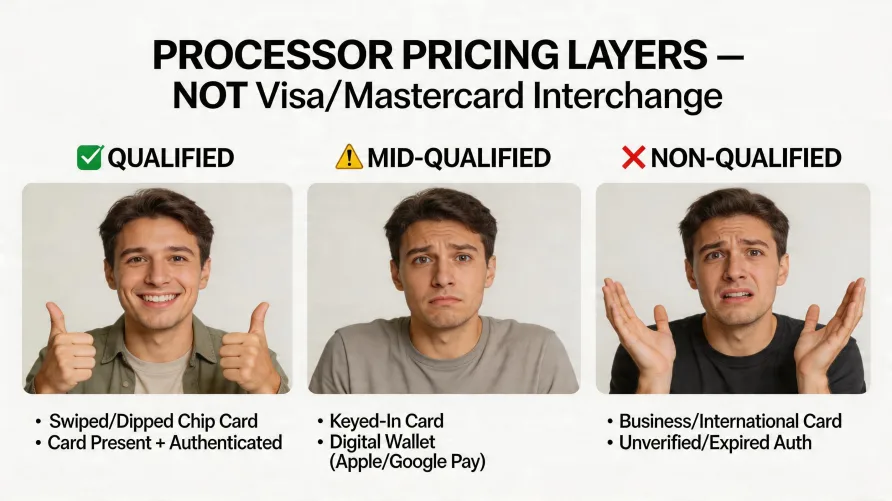
Qualified, mid-qualified, and non-qualified rates aren't actual interchange categories published by Visa or Mastercard. They're a pricing model some processors use to compress a much larger list of real interchange categories into three buckets, and the bucketing rules are set by the processor, not the card networks. The qualified rate gets advertised. The mid-qualified and non-qualified rates apply when the transaction doesn't meet the processor's criteria, which happens more often than most merchants realize. In my 20-plus years buying and operating business software, the credit card statement is one of the most consistently misunderstood documents on a small business owner's desk. The structure looks objective. It isn't. Once you understand how the three-tier model overlays the real interchange schedule, what looks like a low headline rate often resolves into a much higher effective rate. How Interchange Actually Works Visa and Mastercard publish their U.S. interchange schedules each year. Visa's schedule lists more than 100 distinct categories. Mastercard's schedule is similarly granular. Each category has its own rate, generally a base percentage plus a fixed per-transaction fee, and the rate depends on factors including the card type, the entry method, the merchant category code, and the data the merchant submits with the transaction. A standard consumer credit card chip-dipped at a retail terminal pays one rate. The same card keyed in over the phone pays a different rate. A premium rewards card chip-dipped at the same terminal pays a higher rate than the standard card. Interchange revenue goes to the bank that issued the card, not to the processor or the card network itself. The Federal Reserve, under Regulation II (the Durbin Amendment), caps interchange on debit cards issued by banks with more than $10 billion in assets. Credit card interchange has no comparable federal cap in the United States, which leaves card networks and issuers to set the rates published in those category schedules. How Tiered Pricing Repackages Interchange into Three Categories When a processor offers a tiered pricing plan, they take the published list of 100-plus interchange categories and decide which categories map to each of three tiers. The transaction still processes through the network at its real interchange rate. The processor only shows the tier on the merchant statement. The qualified tier is meant to capture the lowest-cost interchange categories. Standard consumer credit cards chip-dipped at a properly configured terminal with the right data submission usually fall here. The qualified rate on a statement is often within 0.10% to 0.30% of the underlying interchange rate, current as of writing. The mid-qualified tier typically catches rewards cards (which carry materially higher interchange), some keyed transactions, and certain card-not-present transactions that meet the processor's data requirements. Mid-qualified rates usually run 1.0% to 1.5% above the qualified rate. The non-qualified tier is the catch-all. Anything that doesn't meet qualified or mid-qualified criteria lands here, including most international cards, many corporate cards, late-settled transactions, and transactions with missing or failed data fields. Non-qualified rates can run 1.5% to 2.5% above the qualified rate, sometimes more. The critical fact is that the processor controls the bucketing rules. There's no industry standard. Two processors can put the same Visa interchange category into different tiers. A merchant on tiered pricing can't audit the bucket assignments from the statement alone, because the underlying interchange categories aren't disclosed line by line. What Causes a Non-Qualified Transaction The triggers fall into a handful of patterns. Card type is the most common one. Rewards credit cards (the Visa Signature, Visa Infinite, Mastercard World, and Mastercard World Elite tiers) carry materially higher interchange than basic consumer cards, and they make up a large share of consumer spending in the United States. On most tiered plans, a swipe of a rewards card downgrades to mid-qualified or non-qualified by default. Entry method is the next major trigger. A retail terminal that expects a chip dip or contactless tap will downgrade a keyed-in card number, because networks treat keyed entry at a card-present location as a fraud risk indicator. Failed Address Verification (AVS) or missing CVV on a card-not-present transaction can also push the transaction into a higher tier. Settlement timing is the trigger merchants miss most often, and it's the most controllable one. Visa and Mastercard expect transactions to be authorized and captured within a defined window, typically one to two business days depending on the underlying interchange category. A batch left open for three or four days can downgrade what would otherwise be a qualified transaction into a higher cost category, even when every other element of the transaction was clean. Most modern processing systems close batches automatically at end of day. If your terminal or gateway lets you defer batch settlement manually, don't. The dollars saved by closing the batch on time will almost always exceed whatever operational reason existed for keeping it open. The same logic applies to authorization-to-capture mismatches. If you authorize a card for one amount and settle for a materially different amount, networks treat that pattern as a downgrade trigger on most retail interchange categories. Other recurring downgrade patterns include the wrong merchant category code for the actual business type, voice-authorized transactions in a card-present environment, missing Level II or Level III data on B2B and government card transactions, and international cards processed without the proper indicators. How to Avoid Interchange Downgrades to Mid-Qualified or Non-Qualified You can't always avoid downgrades, but operationally there's a lot you can do. Use chip or contactless on every in-person transaction. A keyed-in card number at a retail terminal is the single most controllable downgrade trigger I see. Train staff to ask the customer to dip or tap before falling back to keying the number, except when the chip itself fails repeatedly. Settle your batches within 24 hours. If your system supports automatic end-of-day batching, leave it on. If it doesn't, build a daily batch-close into the closing checklist. For card-not-present transactions, send full AVS data and CVV every time. AVS asks the issuer to verify the cardholder's billing address against the address on the transaction. A successful AVS match on the street number and ZIP keeps qualified transactions qualified. A skipped AVS submission almost always triggers a downgrade. If you take card-not-present volume, look at 3-D Secure (the underlying protocol behind Verified by Visa and Mastercard SecureCode). For qualifying transactions, 3-D Secure shifts liability and can keep the transaction in the qualified tier on networks that recognize it. Implementation requires gateway support and isn't free of friction at checkout, but the interchange savings on a substantial share of CNP volume can offset the lift. For business-to-business merchants, submitting Level II or Level III data on purchasing card transactions can move them into a lower interchange category. Level II adds the sales tax amount and customer code. Level III adds line-item detail. The interchange savings on Level III submissions can run 0.50% to 1.0% per transaction for qualifying purchasing card programs, current as of writing. Confirm your merchant category code matches your actual business. If you opened the account as one type of business and shifted operations, the original MCC may now be wrong. The wrong MCC can route transactions through interchange categories that don't match how your business actually operates. What a Tiered Pricing Downgrade Really Costs Here's the part processors don't advertise. On a tiered plan, when a transaction downgrades, the processor pays the network the actual interchange rate (which may be 1.80% for a rewards card, for example) and charges the merchant the non-qualified rate (which may be 3.20%). The spread, in this case 1.40%, goes to the processor. That's why tiered pricing tends to look cheap on the qualified rate and expensive in practice. The advertised rate applies to a minority of transactions in most retail and service businesses, especially anywhere consumer rewards cards dominate the card mix. A merchant who expected a 1.79% rate can end up at a blended effective rate of 2.6% to 3.2% once mid-qualified and non-qualified transactions land on the statement. The alternative pricing model is interchange-plus, sometimes called pass-through. On interchange-plus, the merchant pays the actual published interchange rate for that specific transaction plus a fixed processor markup. A typical interchange-plus markup might be 0.20% plus $0.10 per transaction. The merchant sees the underlying interchange on the statement, which makes the math auditable. Interchange-plus generally costs less for businesses with significant rewards card volume, because the merchant captures the underlying rate rather than absorbing the bucketing spread. Tiered can compete only when the processor sets the qualified rate aggressively low and the merchant's transaction mix happens to skew toward truly qualified categories, which is rare in card-present consumer retail. Reading Your Own Statement If you're on tiered pricing now, look at three things on a recent statement. First, what percentage of your transactions hit the qualified tier versus mid- and non-qualified. If the qualified share is below 60%, the headline rate isn't representative of what you're actually paying. Second, calculate your effective rate by dividing total processing fees by total card volume. If your effective rate is 0.50% or more above the qualified rate you were quoted, the tiered structure is doing exactly what processors design it to do. Third, ask your processor or independent sales agent for an interchange-plus quote based on your existing statements. A reputable processor can run a comparison from prior months. If the answer is that interchange-plus isn't available for businesses your size, that's a signal worth taking seriously. The Bottom Line Tiered pricing isn't always wrong, and not every processor uses it to inflate margins. There are small businesses where a flat blended rate is genuinely simpler to manage, and the dollar difference doesn't justify a more complex statement. But for any business with meaningful card volume, understanding what actually drives a transaction into mid-qualified or non-qualified territory is worth more than any rate negotiation. The downgrades happen because of operational details. Most of those details are within your control. For more detail on providers in this market, see our reviews and ranking page for credit card processing.
Interchange Rate Categories: Qualified, Mid-Qualified, and Non-Qualified