
The Simplest Path to Accepting a Credit Card
Most small businesses aren't shopping for interchange rates or negotiating multi-year merchant contracts. They want to accept a credit card and get paid. Square has built its entire processing service around that expectation, bundling flat-rate fees with a full point-of-sale system that costs nothing on the entry plan. We score Square 8.0 out of 10 for credit card processing — a strong showing driven by its zero-barrier setup, $0 chargeback policy, and surprisingly deep POS software, held back by flat-rate economics that punish growing transaction volumes and a customer support structure that frustrates merchants when problems arise.
From Card Reader to Commerce Platform
Square handles in-person card payments via tap, dip, or swipe; online payments through a built-in website builder and checkout links; invoiced payments with ACH bank transfer options; and manually keyed transactions for phone orders. Every major card brand — Visa, Mastercard, American Express, Discover — processes at the same rate regardless of plan tier, which eliminates the brand-specific fee calculations that trip up newer merchants.
The POS software included on every plan isn't a stripped-down checkout screen. It handles inventory management with low-stock alerts, employee scheduling through Square Shifts, a customer directory that builds profiles from transaction history, and reporting dashboards showing gross sales and top-selling items in real time. Restaurant operators get table layouts, coursing, and kitchen display system integration. Retail businesses get barcode scanning, purchase orders, and vendor management. Appointment-based businesses get online booking calendars and no-show fee collection. In early 2025, Square consolidated all of these vertical-specific tools into a single unified POS app, so you don't need separate downloads for different business types.
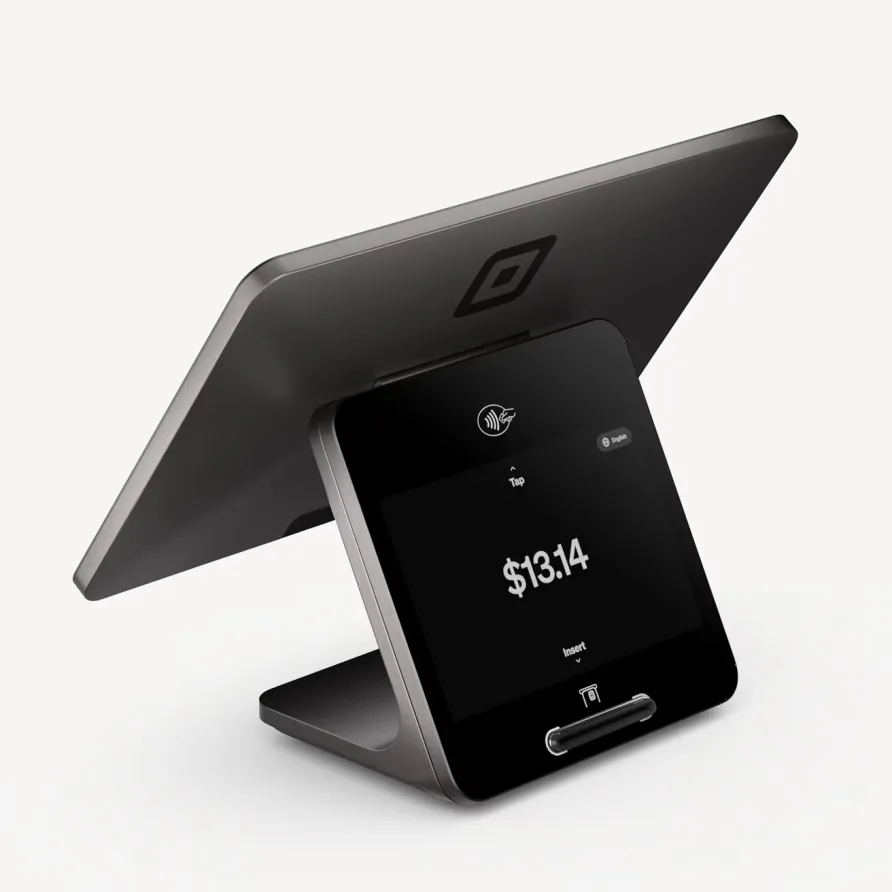
The hardware lineup expanded in May 2025 with Square Handheld, a smartphone-sized POS device weighing just 11 ounces with a 6.2-inch Gorilla Glass screen and IP54 dust and water resistance. TIME named it one of the Best Inventions of 2025. It joins the $59 contactless and chip reader, the $149 Square Stand for iPad-based countertop setups, the $299 Terminal with a built-in receipt printer, and the $899 Register with dual screens. Your first magstripe reader is free, and Tap to Pay on iPhone and Android lets you skip hardware altogether.
One UX detail worth flagging: Square's item library lets you photograph products with a device camera and add them to inventory in seconds, but the tax-assignment step hides behind two menu levels. Setting up a retail catalog with mixed tax categories means extra tapping. The checkout flow itself is fast — users running service-based operations report that tap-to-pay on a phone consistently completes in under three seconds.
What Square Credit Card Processing Costs in Practice
In October 2025, Square replaced 18 separate à la carte subscriptions with three unified tiers. If you signed up before that date and haven't switched, your rates may differ from what's listed here — but every new merchant now lands on the same structure.
The Free plan charges $0 per month. You pay 2.6% + 15¢ per in-person transaction, 3.3% + 30¢ for online payments, and 3.5% + 15¢ for manually keyed entries. That in-person per-transaction fee went up 5¢ from the pre-overhaul rate of 2.6% + 10¢, and the online rate jumped from 2.9% + 30¢ — a meaningful increase if you do any real volume through your website or payment links.
The Plus plan costs $49 per month per location and drops in-person processing to 2.5% + 15¢ and online to 2.9% + 30¢. It also adds staff management tools, loyalty programs, marketing features, and advanced industry-specific POS capabilities. The Premium plan runs $149 per month per location, brings in-person rates down to 2.4% + 15¢, includes 24/7 phone support, and waives gift card load fees.
Here's the annual math. A solo business owner on the Free plan processing $8,000 per month in mostly in-person sales (average ticket of $25, roughly 320 transactions) pays about $2,544 per year in processing fees and $0 in subscription costs. That same owner on Plus would pay $2,184 in processing fees plus $588 in annual subscription, totaling $2,772 — more expensive until monthly volume pushes above roughly $12,000–$15,000. A five-person retail operation processing $30,000 per month in-person on the Plus plan spends approximately $9,540 in annual processing fees plus $588 in subscription, for a total around $10,128. On Premium, processing drops to about $8,820 plus $1,788 in subscription, totaling $10,608 — which means Premium only pencils out when volumes climb considerably higher, or when the lower online rate and 24/7 support justify the monthly cost.
The $0 chargeback fee deserves its own line. Most processors charge $15–$25 per dispute regardless of the outcome. Square absorbs that entirely. If your business handles a significant number of chargebacks — common in restaurants, service businesses, and e-commerce — this single policy can save hundreds annually.
Flat-rate processing is predictable, and that's its selling point. But it also means you're overpaying on low-risk transactions where the actual interchange rate is well below Square's flat percentage. Businesses processing over $250,000 annually can request custom rates, but below that threshold, you're locked into the published numbers.
Is Square the Right Processor for Your Business?
Consider a food truck operator who works four farmers markets a week. She doesn't need a permanent countertop terminal, can't afford a monthly software fee while revenue is still unpredictable, and needs to accept cards on the spot with no setup hassle. Square's Free plan with a $59 reader (or Tap to Pay on her phone) gives her a full POS, real-time sales tracking, and next-day deposits with zero monthly commitment. That's the scenario where Square shines brightest.
Now consider a growing retail store processing $40,000 per month across in-person and online channels. At that volume, the difference between Square's flat rate and an interchange-plus model could amount to $200–$400 per month in unnecessary fees. The Plus plan offsets some of that with lower rates, but interchange-plus processors will almost certainly be cheaper at this scale. The trade-off is losing Square's integrated POS, hardware flexibility, and the simplicity of one provider for everything.
Square fits best for startups, sole proprietors, mobile sellers, and brick-and-mortar operations under roughly $15,000 per month in processing volume. The platform also works well for businesses that need multi-channel selling — in-person, online, invoiced — without stitching together separate tools. If you already operate above $20,000 monthly and your processing costs are a serious line item, run the numbers against interchange-plus alternatives before committing.
Where Square's Model Falls Short
The most persistent complaint across user feedback is account stability. Merchants report having funds held or accounts frozen without advance warning, often after a transaction pattern triggers Square's automated risk detection. A recurring theme from newer merchants is that the deactivation notice arrives with a generic policy reference and no specific explanation of what triggered the review. For businesses that depend on daily cash flow, an unexpected hold can create real operational stress.
Square doesn't support high-risk industries. If your business falls into categories like firearms, adult content, CBD above certain thresholds, or multi-level marketing, you won't get approved — or you'll get shut down after the fact. The list of prohibited business types is published on Square's site, but some merchants in gray-area industries discover the restriction only after they've started processing.
Customer support access depends on your plan. Free and Plus subscribers get chat and email. Phone support is reserved for Premium at $149 per month. Feedback from long-term merchants suggests that chat response times are generally reasonable, but resolving account-level issues — especially fund holds — requires escalation that doesn't always happen smoothly.
The online processing rate increase on the Free plan (from 2.9% + 30¢ to 3.3% + 30¢) is steep. Businesses that sell primarily online and want to stay on the free tier are now paying significantly more per transaction than they were before October 2025. Square effectively pushed online-heavy sellers toward the Plus plan.
Our Verdict
Square occupies a specific and valuable position in credit card processing: it's the fastest path from "I need to accept cards" to actually accepting them, with no application process, no monthly fee on the entry plan, and a POS system that would cost a separate subscription from most other providers. The $0 chargeback policy is a concrete financial advantage that compounds over time, and the October 2025 pricing restructure — despite raising some rates — simplified the plan structure in a way that makes choosing the right tier less confusing. Block, Inc.'s S&P 500 inclusion and $210 billion in annual payment volume give the platform a stability foundation that smaller processors can't match. Where Square asks you to compromise is on cost efficiency at scale and support access when something goes wrong with your account. If you're processing under $15,000 a month and value simplicity over negotiated rates, Square delivers more included value than any flat-rate processor on the market. If your volume is climbing and you've started noticing those per-transaction fees in your monthly P&L, it's time to model what an interchange-plus arrangement would save you — and decide whether Square's convenience is still worth the premium.