
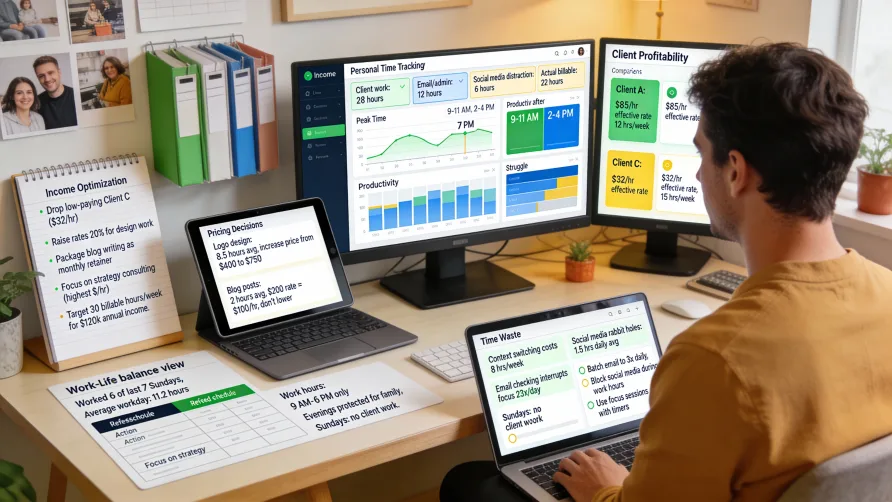
Freelancers face unique productivity challenges compared to traditional employees. Without managers, structured schedules, or clear boundaries between work and personal time, freelancers must self-manage their productivity while juggling multiple clients, projects, and responsibilities.
Time tracking provides freelancers with objective data about how they actually spend their time versus how they think they spend it. This awareness creates opportunities to improve productivity, optimize pricing, identify profitable work, and achieve better work-life balance. Understanding what time tracking reveals helps freelancers make smarter decisions about their business.
Should Freelancers Track Their Time?
The question of whether freelancers should track time depends on how they work and what they want to achieve, but most freelancers benefit significantly from at least periodically tracking their time.
Arguments for Freelancer Time Tracking
Understanding true time investment in projects helps with pricing. Many freelancers undercharge because they underestimate how long work actually takes. Time tracking reveals reality.
Identifying profitable versus unprofitable work becomes possible with time data. Some clients or project types generate good income per hour while others don't, but you can't know without tracking.
Client billing accuracy improves when based on actual tracked time rather than estimates. Hourly billing requires accurate time records, and even fixed-price work benefits from knowing actual time investment.
Productivity patterns become visible through time tracking. Understanding when you're most productive, what activities consume surprising amounts of time, or where you lose focus helps optimize your work patterns.
Work-life balance requires knowing how much you actually work. Freelancers often work more hours than they realize. Time tracking provides objective evidence of work hours versus personal time.
Arguments Against Time Tracking
Administrative overhead concerns some freelancers. Time tracking takes time itself, and freelancers must balance the value of data against the cost of collecting it.
Focus disruption can occur if time tracking interferes with flow states. Starting and stopping timers might break concentration for deep work.
Value-based pricing proponents argue time shouldn't determine pricing. If you charge based on value delivered rather than time spent, detailed time tracking may seem less relevant.
The Balanced Approach
Most freelancers benefit from tracking time at least initially to understand their business, even if they don't track time perpetually.
Track time for a month or quarter to establish baseline understanding of how you spend time and what work is profitable. This data informs decisions even without ongoing tracking.
Continue tracking time for hourly billing clients while optionally not tracking for fixed-price work. Selective tracking reduces overhead while maintaining accuracy where it matters most.
Periodically return to time tracking to validate assumptions and check whether patterns have changed. Annual time tracking sprints provide updated data without continuous tracking burden.
How Does Time Tracking Help Freelancers?
Time tracking provides specific benefits that help freelancers build more successful, sustainable businesses.
Understanding True Time Investment
The gap between perceived and actual time spent on work is often substantial.
Freelancers consistently underestimate how long tasks take. What feels like a two-hour task often consumes four hours when tracked accurately.
Scope creep becomes visible through time tracking. Projects that should take 20 hours but actually consume 35 hours reveal scope management problems.
Administrative time adds up invisibly. Email, invoicing, client communication, and business management consume significant time that many freelancers don't account for.
Context switching costs become apparent. Time tracking shows how much time goes to switching between clients, projects, or task types, revealing efficiency losses.
Identifying Productive Versus Unproductive Time
Time tracking reveals patterns about when and how you work most effectively.
Daily productivity patterns show when you do your best work. You might discover you're most productive in early mornings but waste time in afternoons.
Task-specific productivity varies. You might complete design work efficiently but struggle with client communication tasks that take longer than they should.
Distraction patterns become visible. Tracking shows how much time goes to interruptions, social media, or other activities that don't advance your work.
Deep work versus shallow work balance matters for productivity. Understanding how much time goes to focused project work versus administrative tasks helps optimize your schedule.
Optimizing Pricing Decisions
Time tracking data enables smarter pricing that better reflects actual work required.
Historical time data improves estimates for similar future work. Instead of guessing what to charge, you know what similar projects actually required.
Hourly rate calculations based on target income and available hours become grounded in reality. If you need to earn a certain amount and have specific available hours, you can calculate required hourly rates.
Fixed-price project pricing improves when you understand true time costs. Knowing a typical website project requires 40 hours helps you price appropriately rather than undercharging.
Identifying when to walk away from low-paying work becomes easier. When time tracking shows certain work pays poorly per hour, you can confidently decline it in favor of better opportunities.
Managing Client Relationships
Time tracking helps freelancers manage client relationships more effectively.
Billing accuracy for hourly work requires precise time records. Clients expect accurate invoices, and time tracking provides the documentation to support charges.
Scope conversations backed by data are more productive. When clients request additional work, you can reference actual time data from similar past requests to discuss appropriate fees.
Setting boundaries becomes easier with time evidence. If a client consumes excessive time through frequent meetings or revisions, time tracking provides objective data to support boundary discussions.
Client profitability analysis reveals which relationships are valuable. Some clients who seem lucrative actually consume disproportionate time for the revenue they generate.
Achieving Work-Life Balance
Freelancers often struggle with work-life balance because work lacks clear boundaries. Time tracking provides visibility that helps establish healthier patterns.
Actual hours worked versus intended hours often diverge significantly. You might aim for 40-hour weeks but consistently work 55 hours without realizing it.
Evening and weekend work becomes visible. Time tracking shows whether you're maintaining boundaries or letting work bleed into personal time.
Burnout risk identification happens earlier. When time tracking reveals consistent 60+ hour weeks, you can address the unsustainable pattern before burning out.
Time off tracking shows whether you're actually taking breaks. Freelancers often work through intended vacation time, and tracking reveals this pattern.
Practical Time Tracking for Freelancers
Implementing time tracking as a freelancer requires approaches that balance data value with minimal overhead.
What to Track
Freelancers should track enough to gain useful insights without creating excessive administrative burden.
Client work time including actual project work, client meetings, and client communication. This time directly generates income and should always be tracked.
Business development time spent on proposals, networking, and pursuing new opportunities. This time investment in future work should be visible even though it doesn't immediately generate income.
Administrative time including invoicing, bookkeeping, email management, and other business operations. Understanding administrative overhead helps with capacity planning.
Professional development time for learning, skill building, and industry engagement. This investment in your capabilities has long-term value that should be visible.
Personal time provides context for work-life balance. Some freelancers track personal time to understand total time allocation, though this is optional.
Tracking Methods
Freelancers can choose from several time tracking approaches based on preferences and needs.
Running timers during work provide the most accurate time capture. Start a timer when beginning work and stop it when finishing or switching tasks.
Manual time entry after completing work requires discipline but avoids timer management. At task completion, log how long it took while the information is fresh.
End-of-day batch entry reconciles the day's work in one session. Review what you worked on and log time for each activity.
Calendar-based tracking uses calendar entries as time records. If you calendar-block your work, those blocks can serve as time tracking data.
Tools and Technology
Freelancers need time tracking tools that are simple, accessible, and fit their workflow.
Dedicated time tracking apps designed for freelancers offer features like client/project organization, invoicing integration, and reporting. Many offer free tiers suitable for solopreneurs.
Project management tools with built-in time tracking combine task management and time tracking in one place. This integration reduces tool switching.
Spreadsheet time tracking works for freelancers comfortable with manual tracking. Simple spreadsheets can capture time data without specialized software.
Mobile apps enable tracking from anywhere. Freelancers working at various locations need mobile-accessible time tracking.
Analyzing Time Data for Productivity Improvements
Collecting time data only helps if you analyze it and act on insights.
Regular Review Practices
Establish rhythms for reviewing time tracking data and identifying patterns.
Weekly reviews show immediate patterns. At week's end, review where your time went and whether it aligned with priorities and plans.
Monthly reviews reveal broader trends. Monthly analysis shows whether you're hitting income targets, maintaining work-life balance, and focusing on profitable work.
Quarterly deep dives support strategic decisions. Every three months, thoroughly analyze your time data to make decisions about rates, clients, or service offerings.
Key Metrics to Monitor
Focus on metrics that inform decisions and drive improvements.
Billable utilization shows what percentage of work time generates revenue. High billable utilization indicates efficient business operations, while low utilization suggests too much time on non-revenue activities.
Effective hourly rate divides earnings by total hours worked. This metric reveals your true earning rate including all work time, not just billable hours.
Client profitability compares revenue from each client against time invested. Some clients pay well for minimal time while others generate modest revenue for substantial effort.
Project type profitability shows which kinds of work are most lucrative. Certain project types might generate better hourly rates than others.
Time distribution across work types reveals whether your allocation matches intentions. If you planned to spend 60% of time on client work but actually spend 40%, adjust accordingly.
Taking Action on Insights
Time tracking only improves productivity when you act on what you learn.
Adjust pricing based on true time costs. When time tracking reveals you've been underpricing work, raise rates to reflect actual time investment.
Focus on profitable work by pursuing more of what pays well and avoiding work that doesn't. Time data shows which opportunities are worth pursuing.
Eliminate or delegate unprofitable activities. Tasks that consume time without generating value should be eliminated, automated, or outsourced.
Optimize schedule based on productivity patterns. Schedule your most important work during your most productive hours.
Set boundaries with clients based on time data. When time tracking shows certain clients consume excessive time, establish clearer boundaries or adjust pricing.
Best Practices for Freelancer Time Tracking
Implementing time tracking as a freelancer works best following practices that maximize insights while minimizing burden.
Start Simple
Begin with basic time tracking before adding complexity.
Track at project or client level initially. You don't need task-level detail immediately—knowing how time distributes across clients provides valuable baseline data.
Use straightforward tools that are easy to adopt. Complex enterprise time tracking software may overwhelm solo freelancers.
Commit to tracking for a defined period like one month. Having an endpoint makes starting less daunting.
Track Consistently
Consistent tracking provides reliable data, while sporadic tracking yields incomplete information.
Make time tracking part of your daily routine. Log time at the same time each day, such as end of workday.
Use reminders if needed to build the habit. Calendar notifications or app reminders help establish consistent tracking.
Track even when you don't feel like it. The days you skip tracking are often the days that would provide valuable data.
Keep It Lightweight
Minimize time tracking overhead so it doesn't become a productivity drain itself.
Use simple descriptions that provide context without excessive detail. "Client presentation prep" suffices without a paragraph explanation.
Don't track in overly granular increments. Fifteen or thirty-minute blocks work well for most freelancers without requiring excessive precision.
Batch similar tracking tasks. If you prefer manual entry, log time once or twice daily rather than after every individual task.
Review and Adjust
Periodically assess whether time tracking is providing value and adjust your approach.
Evaluate whether insights from time tracking inform decisions. If the data isn't useful, simplify your tracking or stop.
Adjust tracking detail level based on what proves valuable. Add detail where it helps, eliminate detail that doesn't.
Experiment with different tracking methods to find what works. Running timers work for some people while manual entry works better for others.
Common Mistakes to Avoid
Several common mistakes undermine effective time tracking for freelancers.
Tracking time but never reviewing it wastes effort. Regular analysis is where value comes from.
Perfectionism about time tracking creates excessive overhead. Approximate accuracy is sufficient for most purposes.
Using time tracking punitively against yourself damages motivation. Time tracking should inform decisions, not create guilt.
Only tracking billable time prevents understanding true business costs. Non-billable time is real work that affects your capacity and profitability.
Letting time tracking disrupt flow states. Find tracking methods that don't break concentration during deep work.
Giving up too quickly before habits form. Time tracking requires at least a few weeks to become routine and provide useful data.
Getting Started
Freelancers wanting to improve productivity through time tracking should start strategically.
Choose a time tracking tool appropriate for freelancers—something simple, affordable, and designed for solopreneurs rather than enterprise teams.
Commit to tracking time for one month to establish baseline data. A month provides enough information to see patterns without indefinite commitment.
Track all work time including client work, business development, and administration. Complete data provides the most insights.
Set aside time weekly to review tracked time and identify patterns. Regular review is where insights emerge.
Identify one or two changes to make based on time tracking insights. Act on what you learn rather than just collecting data.
Assess after the initial month whether to continue tracking. Decide whether the insights justify ongoing tracking or whether you have enough information to make changes.
Consider periodic time tracking sprints even if not tracking continuously. Annual or semi-annual tracking months provide updated data without perpetual tracking burden.
Freelancers who implement effective time tracking consistently report better productivity, improved pricing, healthier work-life balance, and more profitable businesses. The visibility into how time is actually spent enables data-driven decisions that compound over time into significant improvements in both income and quality of life.