
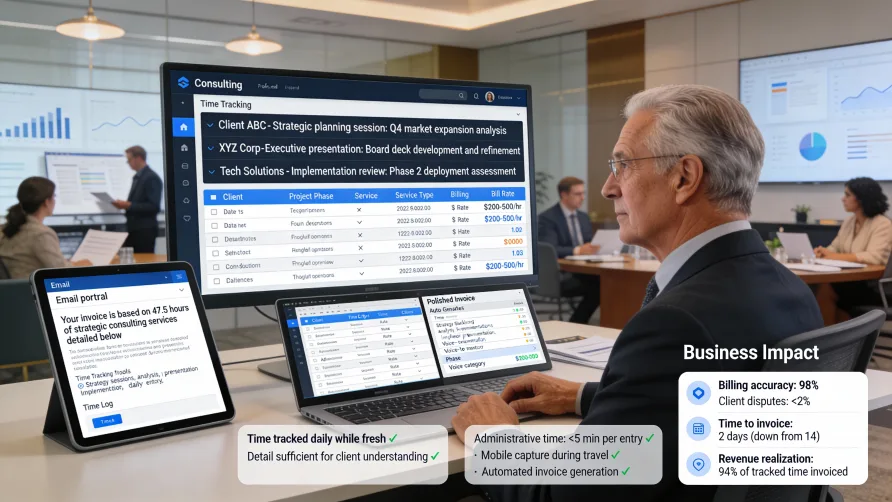
Consulting firms bill clients primarily for professional time and expertise, making accurate time tracking essential for proper invoicing. Unlike product-based businesses where invoice amounts come from price lists, consulting invoices must reflect actual hours worked multiplied by agreed billing rates.
The connection between time tracking and invoicing in consulting is direct and critical. Inaccurate time tracking leads to incorrect invoices that either undercharge clients (losing revenue) or overcharge clients (creating disputes). Understanding how to implement time tracking specifically for consulting invoicing ensures firms get paid appropriately while maintaining client trust through transparent billing.
How Do Consulting Firms Bill Clients?
Consulting firms use several billing models, each with different time tracking requirements and invoicing approaches.
Hourly or Time-and-Materials Billing
Time-and-materials represents the most straightforward consulting billing model where clients pay for actual hours worked at agreed rates.
Consultants track all time spent on client work. Every meeting, research hour, analysis session, and deliverable development gets logged against the client engagement.
Billing rates vary by consultant role and seniority. Partners, principals, managers, and analysts typically have different hourly rates reflecting their experience and expertise level.
Invoices itemize hours worked with descriptions. Clients see line items showing who worked on what, for how long, and at what rate, creating transparency about how professional fees were calculated.
Additional expenses beyond professional time get billed separately. Travel costs, software licenses, data purchases, or other engagement expenses appear as separate invoice line items.
Fixed-Fee or Value-Based Billing
Fixed-fee engagements charge predetermined amounts regardless of hours worked, but time tracking remains important for internal cost management.
Firms track time against fixed-fee projects to understand profitability. Even though the client pays a fixed amount, the firm needs to know whether actual hours stayed within budget.
Time tracking data informs future pricing. Historical time data from fixed-fee projects improves estimates for similar future engagements.
Phase-based billing breaks fixed fees into milestone payments. Rather than one lump sum, clients pay as the engagement progresses through defined phases.
Some fixed-fee arrangements include time caps or not-to-exceed provisions. If the project consumes more than the capped hours, additional fees apply, requiring accurate time tracking to enforce the cap.
Retainer Arrangements
Retainer billing involves clients paying regular fees (typically monthly) for ongoing consulting availability and services.
Time tracking against retainers shows utilization. Firms monitor whether actual hours worked each month stay within the retainer allocation.
Retainer scope defines what work is included. Clear scope agreements prevent disputes about whether specific work falls within the retainer or requires additional billing.
Over-retainer hours may be billable separately. If actual work consistently exceeds retainer hours, additional time can be invoiced at agreed rates.
Under-utilized retainers may or may not roll over unused hours. Retainer agreements specify whether unused monthly hours accumulate or expire.
Blended Models
Many consulting engagements use hybrid billing combining elements of different models.
Base retainer plus project work combines ongoing advisory services with specific project-based engagements. The retainer covers routine support while projects bill separately.
Capped hourly arrangements set maximum fees but bill hourly up to the cap. This approach limits client financial exposure while maintaining hourly billing mechanics.
Phased transitions start as hourly billing then convert to retainer after establishing patterns. Once actual monthly hours stabilize, converting to a retainer simplifies billing.
How Do Consultants Track Their Time?
Effective time tracking for consulting invoicing requires capturing specific information that supports detailed client billing.
Essential Time Entry Elements
Each time entry needs several key pieces of information to support invoicing and client communication.
Client and engagement identification ensures time bills to the correct engagement. Large clients may have multiple simultaneous projects requiring proper allocation.
Date and duration record when work occurred and for how long. Most consulting firms track time in six-minute or fifteen-minute increments, translating to 0.1 or 0.25 hour blocks.
Task or activity descriptions explain what work was performed. Good descriptions provide enough detail that clients understand what they're paying for without requiring excessive narrative.
Team member identification shows who performed the work. This matters because different team members have different billing rates.
Billable status designation marks whether time should be invoiced. Some client-related time like internal coordination may be non-billable.
Rate classification identifies which billing rate applies. Some firms have multiple rate categories (standard, premium, rush) beyond just person-based rates.
Timing of Time Entry
When consultants log time significantly affects accuracy.
Real-time or same-day entry provides the most accuracy. Tracking time immediately after work or at end of day captures hours while details are fresh.
End-of-week entry reduces accuracy. By week's end, consultants forget smaller tasks, misremember durations, or overlook work performed early in the week.
Monthly reconstruction is highly inaccurate. Trying to recreate a month's work from memory produces unreliable data and typically results in underreporting hours.
Running timers during work sessions eliminate estimation. Starting a timer when beginning work and stopping it when finished captures exact duration.
Description Standards
Time entry descriptions need enough detail to support invoicing without becoming burdensome to create.
Client-facing language assumes descriptions will appear on invoices. Avoid internal jargon or abbreviations that clients won't understand.
Specific action verbs clarify what was done. "Analyzed competitive pricing data" is clearer than "worked on pricing project."
Context about deliverables or meetings makes entries meaningful. "Prepared presentation for steering committee meeting" provides more context than simply "presentation work."
Consistent format across the firm improves invoice readability. When everyone describes similar work similarly, invoice line items follow recognizable patterns.
Appropriate detail level balances information with efficiency. Too little detail makes invoices unclear, while excessive detail wastes time during entry.
Billable Versus Non-Billable Time
Consulting firms must clearly distinguish between time that clients will be charged for and internal time.
Billable time includes all work directly advancing client engagements. Client meetings, analysis, research, deliverable development, and client communication are typically billable.
Non-billable time includes internal activities like business development, proposal writing for prospects, administrative work, professional development, and internal meetings unrelated to specific clients.
Relationship maintenance time falls into gray areas. Brief client check-ins might be non-billable relationship building or billable engagement management depending on context.
Proposal time for existing clients may be billable if scoping significant new work. Some firms bill scoping activities while others treat them as business development cost.
Clear policies help consultants mark time appropriately. Without guidance, different people make different decisions about what's billable, creating inconsistency.
Creating Consulting Invoices From Time Data
Converting tracked time into professional invoices requires aggregating time entries, applying rates, and formatting for client consumption.
Aggregating Billable Time
Invoice preparation starts by identifying billable time for the invoicing period.
Filter time entries by client, engagement, and date range to identify what should appear on the invoice. Only billable time within the invoicing period gets included.
Group time entries for invoice presentation. Rather than listing hundreds of individual time entries, group them into logical summary line items.
Calculate hours and charges for each line item by summing time and applying appropriate billing rates. Multiply total hours for each line by the applicable rate.
Sum all line items plus any expenses to reach the total invoice amount. Add applicable taxes to calculate the final amount due.
Invoice Detail Levels
Consulting firms provide varying levels of time entry detail depending on client preferences and engagement terms.
Summary invoices show high-level categories like "Professional Services" with total hours and amount. Detailed time entries are available but not included in the primary invoice.
Moderate detail invoices might show work broken down by major activity categories such as "Strategic Planning - 24 hours" or "Market Analysis - 16 hours."
Detailed invoices include individual time entries or daily summaries showing date, description, consultant name, hours, rate, and amount for each line.
Client contracts or preferences often specify required detail level. Some clients prefer minimal detail while others want to see every time entry.
Supporting Documentation
Beyond the primary invoice, consulting firms often provide additional time tracking documentation.
Detailed time logs attached as appendices show individual time entries. Clients who want full transparency can review complete time records.
Project status reports contextualize invoice amounts. Showing deliverable progress alongside time investment helps clients understand what fees purchased.
Variance reports for fixed-fee projects show budget consumption. When billing against fixed budgets, showing hours spent versus hours allocated provides transparency.
Client Transparency and Communication
Effective consulting invoicing requires clear communication about how time is tracked and billed.
Setting Expectations Upfront
Establish billing expectations during engagement contracting to prevent surprises.
Discuss billing models and rates during proposal phase. Clients should understand how they'll be charged before work begins.
Clarify what activities are billable versus non-billable. Define boundaries about what time will be invoiced to avoid disputes.
Explain invoice format and detail level. Let clients know what information their invoices will contain.
Establish invoicing frequency and payment terms. Clarify whether invoicing happens monthly, at milestones, or on other schedules.
Providing Time Visibility
Many consulting firms give clients visibility into accumulating time before invoices are issued.
Client portals showing time tracking in real-time let clients monitor engagement costs as work progresses. This transparency prevents invoice surprise.
Weekly or biweekly time summaries keep clients informed of time investment. Regular updates about accumulating hours help clients budget appropriately.
Budget alerts when approaching time caps give clients opportunity to decide about additional work before exceeding budgets.
Addressing Invoice Questions
Despite transparency, clients sometimes question invoiced amounts.
Detailed time entries provide evidence supporting charges. When clients question hours, specific time records document what work occurred.
Consultant availability for invoice discussions helps resolve questions. Being accessible to explain invoicing details builds trust.
Willingness to adjust invoices when appropriate maintains relationships. If time was incorrectly billed, promptly crediting the invoice preserves client trust.
Best Practices for Consulting Time Tracking
Implementing time tracking for consulting invoicing works best following practices specific to professional services.
Make Time Tracking a Professional Standard
Consulting firms should establish that accurate time tracking is a professional requirement, not optional.
Position time tracking as essential to client service. Accurate invoicing is part of professional client service, and accurate invoicing requires accurate time tracking.
Include time tracking in performance expectations. Make clear that consistent, accurate time tracking is part of job performance standards.
Train new consultants on time tracking from day one. Build the habit immediately rather than letting poor practices develop.
Track All Client Time
Consulting firms should capture all time related to client engagements, not just obvious billable hours.
Internal meetings about engagements represent real time investment. Strategy sessions, project planning, and team coordination time should be tracked.
Client relationship time beyond specific projects matters for profitability analysis. Networking, check-ins, and relationship maintenance consume capacity.
Travel time should be tracked and billing treatment specified. Some firms bill travel time at full rates, others at reduced rates, others don't bill it, but all should track it.
Review Time Before Invoicing
Review time entries before generating invoices to catch errors and ensure quality.
Verify descriptions are professional and clear. Edit entries with inadequate detail or inappropriate language.
Check for time entry errors like unusual durations or duplicate entries. Obvious mistakes should be corrected before clients see them.
Confirm time is allocated to correct engagements. Misallocated time creates billing errors and client confusion.
Ensure billable status is marked correctly. Time incorrectly marked billable or non-billable affects invoice accuracy and profitability.
Maintain Consistent Billing Cycles
Regular, predictable invoicing helps both cash flow and client relationships.
Invoice on consistent schedules per client agreements. If you've agreed to monthly invoicing, invoice monthly without gaps or delays.
Process invoices promptly at period end. The longer the delay between work and invoicing, the more disconnect clients feel between service and payment.
Communicate if invoicing will be delayed. If circumstances prevent timely invoicing, notify clients about the delay.
Use Technology Appropriately
Technology should streamline time tracking and invoicing without adding complexity.
Integrate time tracking with invoicing or accounting systems. Direct integration eliminates manual data transfer and reduces errors.
Mobile apps enable time tracking from anywhere. Consultants working at client sites or traveling need mobile time tracking capability.
Automated invoice generation from approved time saves administrative effort. Systems that transform approved time into invoice format reduce manual work.
Client portal access to time and invoices provides transparency without creating administrative burden on your team.
Common Mistakes to Avoid
Several common mistakes undermine effective time tracking for consulting invoicing.
Delaying time entry until week's end or month's end significantly reduces accuracy. Track time daily or in real-time.
Inadequate time entry descriptions create unclear invoices that raise client questions. Provide sufficient detail to make entries meaningful.
Failing to distinguish billable from non-billable time produces inaccurate invoices and incorrect profitability understanding.
Not reviewing time before invoicing allows errors to reach clients. Always review time entries before generating invoices.
Inconsistent time tracking across consultants creates equity and quality issues. Establish firm-wide standards and expectations.
Writing off time without client agreement damages profitability. If time was legitimately worked, it should be billed unless there's a specific reason not to.
Getting Started
Consulting firms implementing or improving time tracking for invoicing should approach it systematically.
Select time tracking software designed for professional services with features like multiple billing rates, client/project hierarchy, billable time designation, and invoicing integration.
Configure clients, engagements, and rates accurately. Proper rate configuration is essential for correct invoice calculations.
Establish clear policies about what time to track, required detail level, and timing of entry. Document these standards and train all consultants.
Create invoice templates that present time tracking data professionally. Templates should include your branding and present time information clearly.
Implement timesheet approval workflows where engagement managers review time before invoicing. Approval catches errors and ensures quality.
Generate your first time-based invoices and evaluate results. Assess whether invoices clearly communicate value and calculate correctly.
Gather client feedback about invoice clarity and detail. Some clients may want more or less detail than you initially provided.
Review time tracking and invoicing processes regularly. Identify friction points and opportunities to improve efficiency or accuracy.
Consulting firms that implement effective time tracking and invoicing processes benefit from accurate client billing, improved cash flow, better profitability understanding, and stronger client relationships built on transparency. The investment in proper time tracking systems and practices pays dividends through both revenue capture and client trust.