
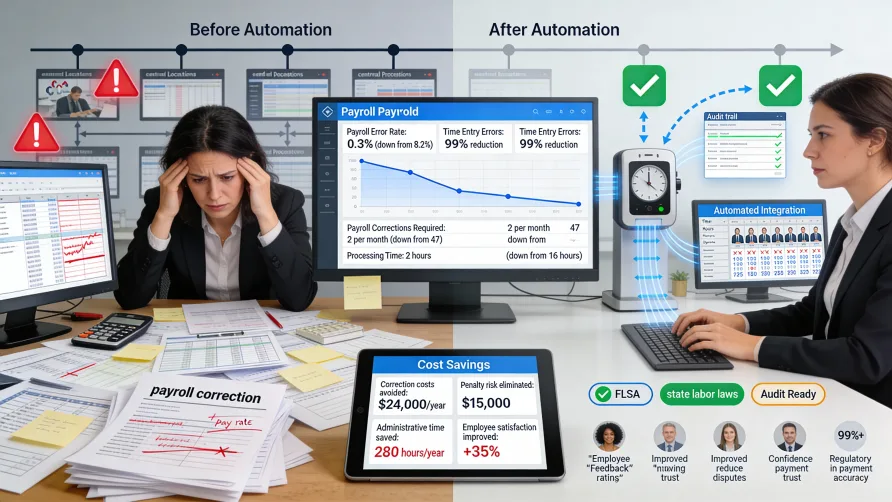
Payroll errors create significant costs for businesses beyond just the financial mistakes themselves. Incorrect paychecks damage employee morale and trust, regulatory penalties for wage and hour violations can be substantial, and the administrative burden of correcting errors consumes HR resources that could be applied to more strategic work.
Manual time tracking processes involving paper timesheets, spreadsheets, or employees self-reporting hours create numerous opportunities for errors to enter payroll calculations. Automated time tracking systems reduce these errors by capturing accurate time data, validating entries, and integrating directly with payroll processing to eliminate manual data transfer.
What Is the Cost of Payroll Errors?
Understanding the true cost of payroll mistakes helps organizations recognize the value of accuracy improvements that automated time tracking provides.
Direct Financial Costs
The most obvious cost is the monetary value of incorrect payments. Overpayments mean the business paid more than owed, while underpayments must be corrected with supplemental payments plus potential interest or penalties.
Correction processing costs add to the direct financial impact. Each payroll error requires administrative time to identify the mistake, calculate the correction, process an adjustment, and update records. These corrections consume HR and payroll staff time that could be spent on other priorities.
Banking and processing fees may apply to correction payments. Issuing additional paychecks or electronic payments to fix errors often incurs transaction fees that wouldn't exist with accurate initial payroll.
Overtime miscalculations represent a common and expensive error type. Incorrectly calculating overtime at regular rates instead of premium rates, or missing overtime entirely, creates significant underpayments that require correction.
Regulatory and Compliance Costs
Wage and hour violations carry substantial penalties. Federal and state labor departments impose fines for violations like unpaid overtime, minimum wage violations, or incorrect record-keeping that often result from payroll errors.
Legal exposure increases when payroll errors harm employees. Wage theft claims, class action lawsuits, and similar legal actions can result from systematic payroll errors, creating costs far exceeding the original mistakes.
Audit findings and penalties result when payroll errors affect tax calculations or regulatory reporting. Incorrect payroll processing can trigger additional scrutiny from government agencies.
Compliance program costs increase after violations. Organizations experiencing payroll compliance problems often face requirements for enhanced oversight, audits, or corrective action plans that create ongoing expenses.
Employee Relations Costs
Trust and morale suffer when paychecks are consistently incorrect. Employees who regularly experience payroll errors lose confidence in their employer and may seek opportunities elsewhere.
Turnover costs increase when payroll problems drive employee departures. The expense of recruiting, hiring, and training replacements far exceeds the cost of implementing systems that prevent payroll errors.
Productivity losses occur when employees spend time addressing paycheck problems instead of doing their jobs. Each payroll error requires employee time to identify, report, and follow up on the mistake.
Reputation damage affects employer brand. Word spreads when a company has chronic payroll problems, making it harder to attract and retain quality employees.
Administrative Burden
HR and payroll staff time spent correcting errors represents opportunity cost. Every hour spent fixing payroll mistakes is an hour not spent on strategic HR initiatives, employee development, or other value-adding activities.
Manager time addressing employee payroll concerns adds to the burden. When employees experience paycheck problems, they turn to their managers for help, consuming management capacity.
System and process complexity increases when organizations implement workarounds to compensate for inaccurate time tracking. The patches and manual interventions added to address chronic problems create additional ongoing work.
Common Sources of Payroll Errors
Understanding where payroll errors originate helps appreciate how automated time tracking addresses root causes rather than just symptoms.
Manual Data Entry Mistakes
Transcription errors occur when payroll staff manually enter time data from paper timesheets or spreadsheets into payroll systems. Every manual data transfer creates opportunity for typos, transposed digits, or misread handwriting.
Calculation errors happen when humans manually compute hours worked, especially for complex scenarios like multiple pay rates, shift differentials, or varied overtime rules. Manual math mistakes are inevitable at scale.
Data entry fatigue increases error rates. As payroll processors work through dozens or hundreds of timesheets, attention wanes and mistakes become more frequent.
Rushed processing near deadlines compounds error rates. When payroll processing happens under time pressure, accuracy suffers as staff rush to complete processing on schedule.
Inadequate Time Tracking Processes
Paper timesheets create multiple error opportunities. Employees may record time inaccurately, supervisors may misread handwriting, and physical timesheets can be lost or damaged.
Spreadsheet-based time tracking lacks validation. When employees enter time into spreadsheets, there's typically no automatic validation of entries, allowing impossible values or calculation errors.
Honor system time reporting invites inaccuracy. When employees simply report hours worked without any systematic tracking, the resulting data reflects estimates and memory rather than actual time.
Delayed time entry reduces accuracy. The longer the gap between when work occurred and when time is recorded, the less accurate the reporting becomes as memories fade.
Complex Pay Rules
Multiple pay rates for the same employee create calculation complexity. When someone earns different rates for different work types, manual calculation of gross pay becomes error-prone.
Overtime rules vary by jurisdiction and employment classification. Calculating overtime correctly requires understanding federal and state rules, employment status, and any contractual agreements—complexity that invites mistakes.
Shift differentials and premiums add calculation steps. When certain hours earn premium rates based on when they're worked, accurate calculation requires correctly identifying which hours qualify.
Paid time off and leave interactions with regular pay create complexity. Correctly handling partial weeks with paid leave, leave accruals, and leave payouts requires careful calculation.
System Integration Failures
Disconnected time tracking and payroll systems require manual data transfer. When time tracking data lives in one system and payroll processing happens in another, someone must manually move data between systems.
Export and import processes introduce errors. Even when systems can exchange data through files, the export/import process can corrupt data, drop records, or introduce formatting problems.
Multiple data sources create reconciliation challenges. When time data comes from various sources that must be combined for payroll, ensuring consistency and completeness becomes difficult.
Version control problems occur when data changes after export. If time tracking data is corrected after being exported to payroll, the payroll system may process outdated information.
How Does Time Tracking Improve Payroll Accuracy?
Automated time tracking addresses the root causes of payroll errors through several mechanisms that improve data quality and reduce manual handling.
Accurate Time Capture
Automated time clocks record precise clock-in and clock-out times without relying on employee memory or estimation. When employees use digital time clocks, mobile apps, or biometric devices, the system captures exact timestamps.
Running timers eliminate estimation errors. When employees start timers as they begin work and stop them when finished, tracked time reflects actual duration rather than approximations.
GPS and geofencing verification ensure time entries correspond to actual presence at work locations. For field workers or remote employees, location data confirms people were where they should be when recording time.
Biometric verification prevents buddy punching. Fingerprint or facial recognition time clocks ensure the person clocking in is actually the employee, not a coworker doing them a favor.
Real-Time Validation
Automated systems validate time entries as they're created. Validation rules can flag impossible values like negative hours, future timestamps, or durations exceeding 24 hours.
Duplicate entry prevention catches when employees accidentally clock in twice or when data entry errors create duplicate records. The system can automatically prevent or flag duplicates.
Missing punch detection alerts supervisors when employees forget to clock out or miss clock-ins. Automated alerts enable timely correction rather than discovering missing data during payroll processing.
Schedule variance alerts notify managers when actual time differs significantly from scheduled hours. Large variances may indicate errors, unauthorized overtime, or schedule adherence problems requiring attention.
Automated Calculations
Automated overtime calculation applies correct rules consistently. The system calculates overtime based on configured federal and state rules, employment classifications, and contractual terms without manual math.
Shift differential application happens automatically based on configured rules. The system identifies which hours qualify for premiums and calculates differential pay correctly.
Multiple pay rate handling calculates gross pay correctly when employees work at different rates. The system applies the correct rate to the right hours and sums them accurately.
Rounding rules apply consistently. Whether you round time entries to nearest quarter hour or use other rounding conventions, automated application ensures consistency.
Direct Payroll Integration
Seamless data flow from time tracking to payroll eliminates manual data entry. When systems integrate directly, approved time automatically transfers to payroll processing without human intermediaries.
Single data source reduces discrepancies. When payroll pulls time data directly from the time tracking system, there's one authoritative source rather than multiple copies that might diverge.
Real-time sync keeps systems current. Rather than periodic batch transfers, continuous integration ensures payroll always has current time data.
Automated mapping translates time tracking data into payroll system formats. The integration handles differences in data structures and field names without manual intervention.
Approval Workflows
Structured timesheet review catches errors before payroll processing. When managers review and approve timesheets before they reach payroll, obvious mistakes get corrected early.
Exception highlighting focuses attention on anomalies. Rather than reviewing every time entry, managers can focus on exceptions flagged by the system.
Approval history creates accountability. When approvers electronically sign off on time data, there's a clear record of who validated information before payroll.
Escalation for unresolved issues ensures problems don't slip through. If timesheets have unresolved exceptions at approval deadline, the system can escalate to ensure resolution before payroll processes.
Quantifying Error Reduction
Organizations implementing automated time tracking typically experience measurable improvements in payroll accuracy.
Error Rate Metrics
Baseline error rates before automation provide comparison points. Many organizations using manual time tracking experience payroll error rates of 1-8% depending on process maturity and complexity.
Post-automation error rates typically drop substantially. Organizations often report error rate reductions of 50-90% after implementing automated time tracking and payroll integration.
Tracking specific error types shows where automation has the most impact. Overtime calculation errors, data entry mistakes, and missing time entries typically see the largest reductions.
Continuous monitoring maintains improvements. Ongoing error tracking ensures accuracy gains persist and identifies new error sources that emerge.
Cost Savings
Correction processing time reduction translates directly to cost savings. HR and payroll staff spend less time fixing mistakes and more time on strategic work.
Compliance penalty avoidance saves money and reputation. Fewer wage and hour violations mean lower regulatory penalties and reduced legal exposure.
Reduced turnover from paycheck problems delivers long-term savings. When employees receive accurate paychecks consistently, turnover related to payroll dissatisfaction decreases.
Banking and transaction fee reduction occurs when fewer correction payments are needed. Eliminating supplemental paychecks saves transaction costs.
Efficiency Gains
Payroll processing time decreases when data is accurate and arrives ready for processing. Payroll teams can complete processing faster with fewer corrections and investigations.
Manager time freed from payroll issue resolution can be redirected to coaching and development. When managers don't field paycheck complaints, they can focus on supporting their teams productively.
Employee time saved from payroll issue follow-up improves productivity. Employees who don't need to chase down paycheck errors spend more time on their actual jobs.
Implementation Considerations
Realizing error reduction benefits from automated time tracking requires thoughtful implementation.
System Selection
Choose time tracking systems with strong payroll integration capabilities. Native integration with your payroll platform provides the most seamless data flow and lowest error rates.
Validate that the system supports your specific pay rules including overtime regulations, shift differentials, and other complexity. Generic time tracking may not handle your unique requirements.
Ensure the system provides adequate validation and exception management. The system should catch errors and provide tools for resolving them before payroll processing.
Consider user experience for both employees and managers. Systems that are difficult to use experience lower compliance, which undermines accuracy benefits.
Configuration
Accurately configure pay rules in the time tracking system. Incorrect configuration of overtime rules, rounding policies, or rate structures will produce incorrect data regardless of automation.
Set up appropriate validation rules to catch errors without creating excessive false positives. Overly aggressive validation frustrates users while inadequate validation misses problems.
Configure approval workflows that match your organizational structure and requirements. Effective approval processes catch errors while maintaining efficient payroll timelines.
Test thoroughly before going live. Process test payrolls using time tracking data to verify accuracy before relying on the system for actual payroll.
Training and Change Management
Train employees on proper time tracking procedures. Even automated systems require users to clock in and out correctly and follow proper procedures.
Train managers on their approval responsibilities. Managers need to understand what they're approving and how to handle exceptions effectively.
Communicate the benefits of accurate time tracking to build buy-in. When employees understand that automation helps ensure accurate paychecks, they're more likely to cooperate.
Provide ongoing support as users adjust to new systems. Answer questions quickly and address problems promptly to maintain confidence in the new approach.
Monitoring and Improvement
Track error rates and accuracy metrics after implementation. Measure whether you're achieving expected error reductions and identify any new problems.
Review exception reports regularly to identify patterns. Recurring exceptions might indicate configuration problems, training gaps, or process issues.
Gather user feedback about system functionality and usability. Users often identify opportunities for improvement that administrators might miss.
Continuously refine configuration and processes based on experience. As you learn how the system performs in your environment, adjust settings and procedures for optimal results.
Getting Started
Organizations looking to reduce payroll errors through automated time tracking should approach implementation systematically.
Document current payroll error rates and correction costs to establish baseline metrics. Understanding your current state quantifies the improvement opportunity.
Evaluate time tracking systems with strong payroll integration appropriate for your business size and complexity. Focus on solutions that address your specific error sources.
Pilot with a department or location before organization-wide rollout. Piloting lets you identify and address issues before they affect the entire organization.
Invest in thorough training for all users. The technology alone doesn't prevent errors—users must understand how to use it correctly.
Monitor results closely during early implementation. Track error rates, user compliance, and system performance to verify that automation is delivering expected benefits.
Adjust based on results and feedback. Be willing to modify configuration, processes, or training based on actual experience with the system.
Calculate ROI periodically to justify ongoing investment. Document error reduction, cost savings, and efficiency gains to demonstrate value.