
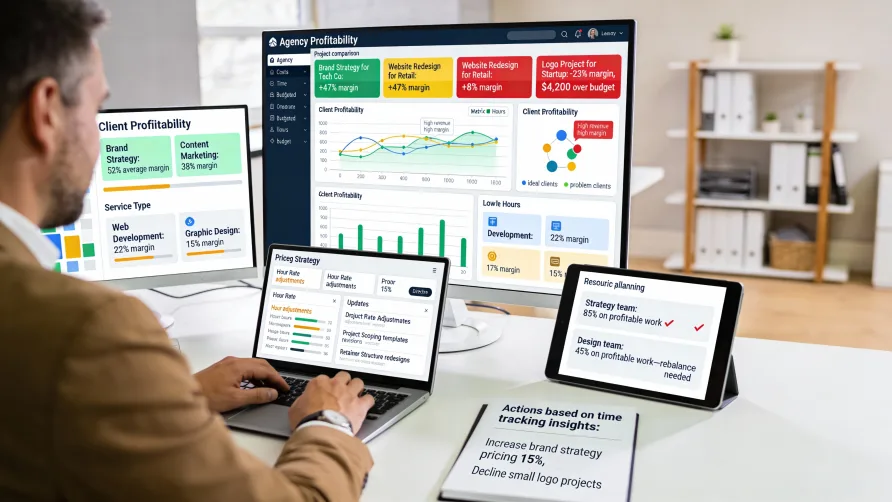
Agency profitability is notoriously difficult to predict and manage. Projects that seem profitable based on initial estimates often lose money when actual time investment exceeds budgets. Clients who appear lucrative based on billings may actually drain resources when you account for all hours worked including revisions, meetings, and scope creep.
Time tracking provides the data agencies need to understand true project costs, identify which work actually generates profit, and make informed decisions about pricing, scoping, and resource allocation. Without accurate time tracking, agencies operate on assumptions and estimates rather than facts about what work costs to deliver.
How Do Agencies Measure Project Profitability?
Project profitability for agencies requires comparing revenue from the project against all costs to deliver it, with labor representing the largest cost component.
Basic Profitability Calculation
The fundamental profitability formula is straightforward: revenue minus costs equals profit. For agencies, the primary cost is labor.
Project revenue includes all amounts billed or budgeted for the project. For fixed-fee projects, revenue is the agreed price. For hourly projects, revenue is actual billings based on time tracked.
Labor costs represent the largest expense. Calculate labor cost by multiplying hours worked by the loaded hourly cost for each team member. Loaded cost includes not just salary but also benefits, taxes, overhead, and other employee costs.
Other project costs might include contractor fees, software licenses, stock imagery, paid media, or other direct expenses. These costs vary by project type and agency specialty.
Gross profit is revenue minus direct costs. This metric shows what the project contributes before accounting for agency overhead and general expenses.
Profit margin expresses profitability as a percentage. Divide gross profit by revenue to calculate margin, which enables comparison across projects of different sizes.
The Challenge of Accurate Cost Data
Calculating profitability requires knowing actual costs, which demands accurate time tracking. Without reliable time data, agencies can only estimate costs, leading to incorrect profitability conclusions.
Estimated hours versus actual hours often diverge significantly. Projects that seem profitable based on initial estimates can lose money when reality doesn't match expectations.
Unbilled time represents hidden costs. When team members work on projects without logging time, or when time is logged but not billed, those costs are real even if invisible.
Scope creep without corresponding fee increases erodes profitability. Additional work beyond original scope consumes time that wasn't budgeted or priced.
Internal time spent on client work including status meetings, coordination, and project management must be captured. These hours represent real costs even if not directly producing deliverables.
How Do Agencies Track Time?
Agency time tracking needs to capture enough detail to support profitability analysis while remaining efficient enough that team members actually use it consistently.
Client and Project Hierarchy
Most agencies organize time tracking around clients and projects within clients.
Client-level tracking aggregates all time for a specific client across all their projects. This view shows total client relationship costs including active projects, proposals, coordination, and relationship maintenance.
Project-level tracking shows time investment for specific engagements. This granularity enables calculating profitability for individual projects.
Task or phase tracking within projects provides detail about work composition. Understanding how time distributes across strategy, design, development, revisions, and other phases illuminates where budgets consume.
Service or discipline tracking shows time by specialty. Breaking down projects by design, copywriting, development, or other disciplines helps understand which services are profitable.
Billable Versus Non-Billable Time
Agencies must distinguish between time that clients will be charged for and time spent on internal or unbillable activities.
Billable time includes client work that will be invoiced. For hourly projects, all productive work is typically billable. For fixed-fee projects, billable designation helps track costs against the fixed budget.
Non-billable time includes internal meetings, business development, proposals for prospects, professional development, and administrative work. This time represents agency overhead rather than direct project costs.
The billable-to-non-billable ratio affects agency profitability. Higher billable ratios mean more capacity generates revenue, while low ratios indicate substantial time goes to non-revenue activities.
Client relationship time falls into gray areas. Some client communication and meetings are billable project work, while other interactions represent relationship maintenance that isn't billable.
Billing Rates and Loaded Costs
Time tracking systems need both billing rates for client invoicing and loaded costs for profitability calculation.
Billing rates determine what clients are charged per hour. Rates typically vary by team member role, seniority, or specialty. Senior strategists bill higher than junior designers.
Loaded costs represent what each hour actually costs the agency. Loaded cost includes salary divided by billable hours plus burden for benefits, taxes, overhead, and unbillable time.
The spread between billing rate and loaded cost determines margin. If a designer bills at $150/hour but costs the agency $80/hour loaded, the margin is $70/hour or roughly 47%.
Understanding both billing rate and cost for each team member enables accurate profitability calculation. Tracking time by person allows applying the correct cost rate to each hour.
Phase and Milestone Tracking
Many agencies track time by project phase or milestone to understand where projects consume budget.
Discovery and planning phases typically occur early. Tracking time in these phases shows whether upfront investment matches fees allocated.
Design and creative development phases often represent significant time investment. Understanding design time versus budgets reveals whether creative work is profitable.
Development and production phases vary dramatically by agency type. For digital agencies, development may consume most project time, while for traditional agencies, production might be minimal.
Revisions and refinements represent scope risk. Tracking revision time separately from initial development shows whether change management processes are effective.
Project management and coordination time needs capture. PM hours are real costs that must be factored into profitability even if not directly producing deliverables.
Calculating Project Profitability
With accurate time tracking data, agencies can calculate true project profitability and identify patterns in which work makes money.
Fixed-Fee Project Analysis
Fixed-fee projects create profitability risk since revenue is predetermined while costs vary based on actual hours.
Compare actual labor cost against fixed fee. Multiply total hours by appropriate loaded cost rates, then compare to the project fee. The difference is gross profit.
Calculate effective hourly rate. Divide project fee by total hours to see what you effectively earned per hour. Comparing effective rate to typical billing rates shows whether the project was priced appropriately.
Identify where hours exceeded budget. Breaking down time by phase shows whether you underestimated specific work types or whether scope expanded.
Analyze revisions and changes separately. Understanding how much time went to changes versus original scope helps improve change order processes.
Hourly Project Analysis
Hourly projects have less pricing risk but require attention to whether all billable time is captured and whether rates are appropriate.
Verify billable time was actually billed. Compare billable time tracked to hours invoiced to ensure you billed for all client work.
Calculate margin on billed work. Compare billed amounts to labor costs for the billed hours to understand profitability of what you charged.
Identify write-offs where billable time wasn't billed. Time tracked as billable but not invoiced represents lost revenue.
Assess whether billing rates are adequate. If margins are thin despite billing all hours, rates may need adjustment.
Retainer Project Analysis
Retainer projects involve fixed monthly fees for ongoing services, requiring analysis of whether the retainer covers actual work.
Compare monthly retainer amount to actual labor cost. Calculate whether hours worked each month cost more or less than the retainer fee.
Track utilization trends over the retainer term. Early months might under-utilize the retainer while later months exceed it, requiring analysis of the full period.
Identify retainer scope clarity issues. If actual work consistently exceeds retainer value, scope may be poorly defined or creeping beyond agreement.
Calculate whether retainer is profitable over time. Some months may run negative while others run positive, requiring evaluation of average profitability.
Client-Level Profitability Analysis
Beyond individual projects, agencies need to understand total client profitability including all interactions and work.
Total Client Time Investment
Client profitability requires accounting for all time related to the relationship, not just specific project hours.
Active project time represents direct client work. This is typically the largest component of client time investment.
Proposal and sales time invested to win new projects with existing clients represents real cost. If you spend 40 hours pitching a project you don't win, that's a cost against the client relationship.
Status meetings and coordination beyond project work time consume capacity. Regular client check-ins, relationship maintenance meetings, and coordination calls are part of relationship cost.
Internal client coordination and strategy discussions about the client represent costs. Account team meetings, strategy sessions, and planning discussions consume time that should factor into client profitability.
Client Lifetime Value
Agencies should analyze clients based on total profitability across the relationship, not just single projects.
Total revenue across all projects and time periods shows client relationship value. Multi-year clients may be highly valuable even if individual project margins vary.
Total costs including all time invested in the relationship shows true cost to serve. Some clients consume disproportionate time for the revenue they generate.
Net client profitability is total revenue minus total costs. This calculation reveals which clients are actually profitable relationships.
Client acquisition cost should be factored for newer relationships. The time spent in sales, onboarding, and initial projects represents investment in the relationship.
High-Maintenance Client Identification
Time tracking reveals which clients consume excessive capacity relative to revenue.
Revision and change request time compared to total project time shows change intensity. Clients requiring extensive revisions may not be profitable even if they pay well.
Meeting and communication time as a percentage of total time indicates client communication needs. Some clients require far more meeting time than others.
Out-of-scope work that wasn't billable shows scope management challenges. Clients who frequently request additional work without paying for it erode profitability.
Rush work and expedited delivery time premium indicates whether clients respect your processes. Frequent rush requests create inefficiency that impacts profitability.
Using Time Data for Better Decisions
Time tracking data enables agencies to make informed decisions that improve overall profitability.
Pricing Improvements
Historical time data dramatically improves pricing accuracy for future projects.
Estimate accuracy improves when based on actual past performance. Instead of guessing how long work takes, you know how long similar projects actually required.
Identify consistent underestimation patterns. If you routinely underestimate specific project types or phases, you can adjust future pricing accordingly.
Buffer sizing based on historical variance. Understanding typical variance between estimates and actuals helps size appropriate contingency.
Rate adjustments informed by margin analysis. If margins are consistently thin across projects, rates may need adjustment upward.
Scope Management
Time tracking shows where scope expands and how to better control it.
Revision time patterns reveal scope control effectiveness. Excessive revision time suggests unclear requirements, inadequate approval processes, or scope creep.
Change request profitability analysis shows whether your change process works. If change requests consume time without corresponding revenue, the change process needs improvement.
Phase budget consumption tracking enables proactive scope management. When a phase is consuming budget faster than expected, address scope before exhausting the budget.
Resource Allocation
Understanding profitability by project type and client helps optimize resource allocation.
Focus senior talent on highest-value work. When you know which work is most profitable, assign your best people to maximize that work.
Identify unprofitable work to minimize or eliminate. If certain project types consistently lose money, consider stopping offering them or fixing the profitability problem.
Balance workload toward profitable clients. When capacity is constrained, prioritize clients and projects with better margins.
Service Line Optimization
Time tracking reveals which services are profitable and which aren't.
Profitability by discipline or service shows which offerings make money. Your design services might be highly profitable while your social media management loses money.
Consider discontinuing unprofitable services unless they serve strategic purposes. If a service consistently loses money and doesn't generate other valuable work, stop offering it.
Invest in profitable service expansion. When certain services generate strong margins, consider building more capacity in those areas.
Agency-Specific Best Practices
Implementing time tracking for profitability in agency environments requires practices tailored to agency business models.
Make Time Tracking Non-Negotiable
Agency profitability depends on accurate time data, making consistent time tracking essential.
Establish that time tracking is a job requirement, not an optional activity. Make clear that completing accurate timesheets is as important as delivering client work.
Track daily rather than weekly or monthly. Daily time entry while work is fresh dramatically improves accuracy over reconstructing time later.
Address time tracking compliance issues promptly. When team members don't track time consistently, intervene quickly to prevent it becoming a habit.
Capture All Client Time
Agency profitability analysis requires accounting for all time related to clients and projects, not just directly billable hours.
Track internal meetings about projects. Time spent discussing projects internally is real cost even if not directly producing deliverables.
Log proposal and pitch time against prospects or clients. This time represents real investment that should factor into profitability analysis.
Record relationship maintenance activities. Client check-ins, networking, and relationship building consume time that affects client profitability.
Review Profitability Regularly
Make project and client profitability analysis a regular practice, not an annual exercise.
Monthly project profitability reviews identify problems while there's still time to correct them. Waiting until project completion to discover unprofitability is too late.
Quarterly client profitability analysis reveals relationship value. Regular review helps decide which client relationships to invest in and which to reconsider.
Annual service line profitability assessment guides strategic decisions about which services to emphasize or discontinue.
Use Profitability Data in Sales
Profitability insights should inform business development and sales strategies.
Price new work based on historical profitability data. Don't rely on guesses about what projects cost—use actual data from past similar work.
Qualify prospects based on likely profitability. If certain project types or client characteristics historically indicate low profitability, factor that into pursuit decisions.
Negotiate scope and fees based on cost understanding. When you know what work actually costs, you can negotiate more effectively for appropriate fees.
Balance Profitability With Strategy
While profitability is crucial, don't make purely financial decisions without considering strategic factors.
Some unprofitable work may serve portfolio or capability building purposes. A prestige client might not be highly profitable but provides valuable credentials.
New service lines may be unprofitable initially while you build capability. Early projects in new areas often lose money as you climb the learning curve.
Client relationship investment sometimes requires accepting lower profitability. Landing a major new client might justify taking initial projects at lower margins to build the relationship.
Common Mistakes to Avoid
Several common mistakes undermine effective use of time tracking for profitability management.
Tracking time inconsistently creates unreliable data. Profitability analysis is only as good as the time data it's based on.
Only tracking billable time prevents understanding true project costs. Non-billable time spent on projects represents real cost that must be captured.
Not analyzing profitability until projects complete misses opportunities to course-correct. Monitor profitability throughout projects, not just at the end.
Accepting unprofitable work without strategic rationale slowly undermines agency health. Consistently taking projects that lose money creates financial problems.
Failing to adjust pricing based on cost data means repeating the same profitability mistakes. Use time tracking insights to improve pricing.
Not communicating profitability expectations to team members. When team members understand project budgets and profitability, they can make better decisions about how to allocate their time.
Getting Started
Agencies wanting to improve profitability through better time tracking should implement systematically.
Select time tracking software designed for agencies with features like billable time tracking, multiple billing rates, project hierarchy, and profitability reporting.
Configure clients, projects, and rates accurately in the system. Accurate rate configuration is essential for correct profitability calculation.
Establish clear time tracking policies about what to track, how frequently, and what detail is required. Train the entire team on these expectations.
Start analyzing profitability as soon as you have a few weeks of data. Don't wait for perfect data to begin generating insights.
Review time tracking and profitability data in regular team meetings. Make profitability analysis part of your ongoing agency management practice.
Use profitability insights to make actual business decisions about pricing, scope management, and resource allocation. Time tracking only provides value when it informs action.
Iterate on your time tracking approach based on what proves useful. Add detail where it generates insights, simplify where tracking doesn't provide value.
Agencies that implement effective time tracking and profitability analysis consistently outperform those operating on assumptions. The visibility into true project costs, client profitability, and service line performance enables data-driven decisions that directly impact margins and overall agency health.